
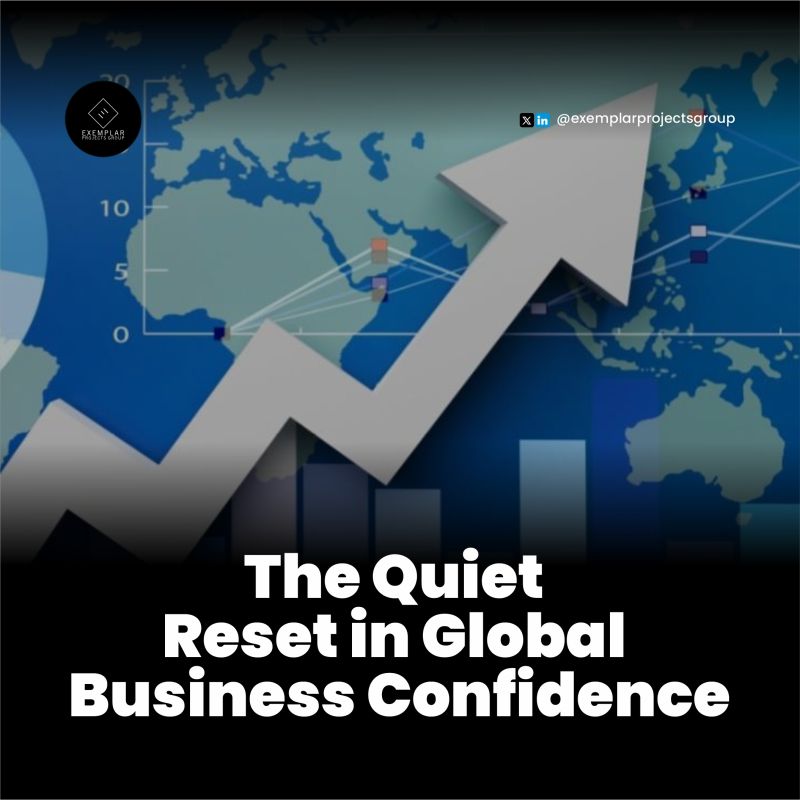
The Quiet Reset: Navigating the Global Crisis of Business Confidence
5 February 2026
There is a subtle problem unfolding in today's business environment — one many leaders recognise instinctively but rarely name. It is not a collapse of markets or the arrival of a formal recession. It is a quiet reset in confidence, revealed not through panic, but through hesitation.
Across industries, decisions are slowing. Expansion plans are reviewed repeatedly, hiring is measured, and capital is held back longer than before. What appears to be indecision is often something deeper. Confidence has become fragile in a world where uncertainty is no longer episodic, but constant.
PwC's CEO outlook shows declining confidence in the global economy, even as executives acknowledge that opportunity still exists. The challenge is no longer one defining crisis, but the accumulation of pressures — geopolitical tension, regulatory shifts, changing consumer behaviour, and relentless technological change. Over time, this combination has produced strategic fatigue.
Caution, in itself, is not the issue. In many cases, it is rational. The risk emerges when caution hardens into slothfulness. Markets do not pause while leaders wait for clarity — customers continue to evolve, competitors adapt quietly, and cost structures shift regardless. When action is delayed for too long, competitive ground is often lost without immediate visibility.
Several European manufacturers have noted that while demand remains stable, investment decisions are being postponed due to unclear economic signals. The outcome has not been protection, but slower innovation and weakening competitive position. Confidence, in these instances, did not collapse; it eroded gradually.
Therefore, in today's climate, confidence should be rooted in preparedness rather than speed. Businesses navigating this reset effectively are not standing still — they are strengthening internal systems, preserving liquidity, and making smaller, deliberate moves that keep them flexible. Instead of waiting for certainty, they are building the capacity to act without it.
This approach aligns with resilience research, which consistently shows that organisations that endure prolonged uncertainty are not those that predict the future most accurately, but those that adapt most effectively. They replace rigid forecasts with scenario thinking, decentralise decision-making, and maintain strategic clarity even as conditions shift.
The quiet reset in global business confidence is therefore not a warning sign, but a signal. It is urging leaders to move away from performative growth and towards durable strategy. Those who treat this moment as recalibration will emerge stronger. Those who mistake waiting for safety may eventually realise that confidence is not restored through hesitation, but through disciplined and intentional movement forward.
More articles
 Digital Marketing
12 Aug 2026
The Real Competition in Digital Content Is Not Followers — It's Seconds
 Business Strategy
15 Jul 2026
Decision Paralysis in Modern Workplaces
 Technology
2 Jul 2026
AI and the Future of Work: Replacement or Redesign?
SWAVE Money
Ready to bank smarter?
Zero-data banking, instant transfers, and real rewards. Download SWAVE Money today.