
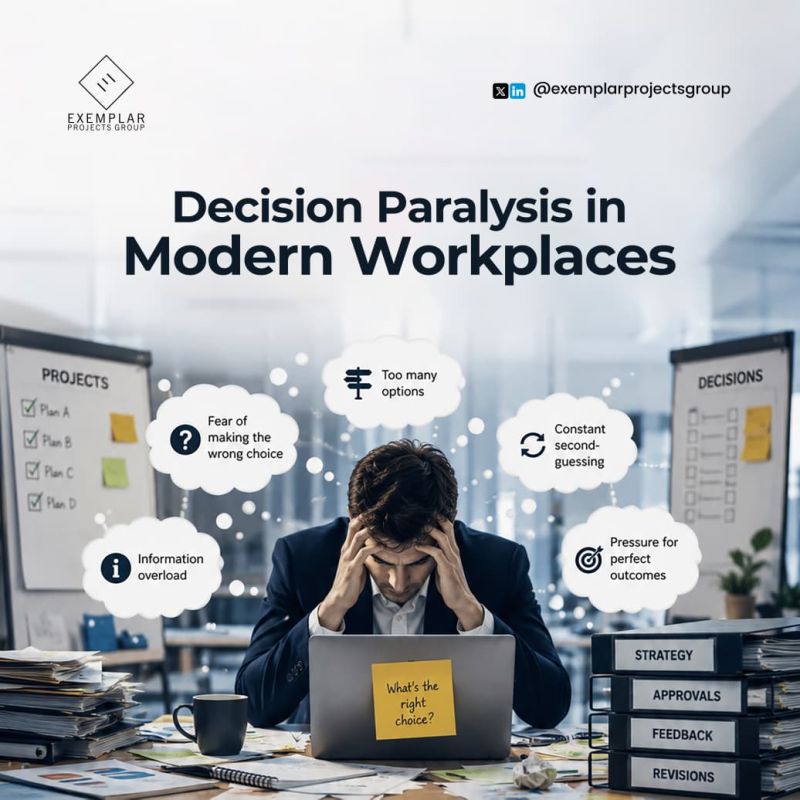
Decision Paralysis in Modern Workplaces
15 July 2026
In many modern workplaces, meetings no longer suffer from lack of information. They suffer from something more subtle and costly: the inability to decide. Teams gather with clear agendas, prepared data, and defined problems, yet still leave without clear outcomes.
At first, the meeting feels structured. Updates are shared, perspectives are exchanged, and issues are laid out in detail. But gradually, the conversation shifts from solving the problem to continuously revisiting it. Points are repeated, clarifications multiply, and what should have been a decision becomes an extended discussion about readiness.
A Harvard Business Review study on managerial effectiveness highlights this pattern, noting that a large share of workplace meetings fail to produce clear decisions despite consuming significant working hours. It describes this as "analysis without closure," where teams process information extensively but struggle to transition into commitment.
In practice, this appears in many product and operations teams. A feature or project that is technically ready for approval gets delayed through repeated review cycles. Each session ends with the same outcome: more alignment is needed. Not because of disagreement, but because no one is clearly responsible for final closure.
This is where decision paralysis begins. It is not driven by lack of intelligence or effort, but by over-involvement in validation and under-assignment of ownership. When everyone is allowed to question, but no one is empowered to conclude, momentum slows even when clarity exists.
The cost of this pattern is rarely visible in the meeting itself. It shows up later in missed deadlines, stalled execution, and opportunities that lose value while still being discussed.
Ultimately, decision paralysis is not a communication problem. It is a structural one. And until organizations shift from over-discussion to clear ownership of final decisions, many workplaces will continue to confuse activity with progress, and discussion with execution.
More articles
 Business Strategy
22 May 2026
The Productivity Illusion: Why Being Busy Isn't the Same as Being Effective
 Digital Marketing
12 Aug 2026
The Real Competition in Digital Content Is Not Followers — It's Seconds
 Technology
2 Jul 2026
AI and the Future of Work: Replacement or Redesign?
SWAVE Money
Ready to bank smarter?
Zero-data banking, instant transfers, and real rewards. Download SWAVE Money today.